On this page12 sections
- What Does It Cost to Build Your Own Online Course Platform?
- What Changed in 2026
- Step 1: Decide What You Are Actually Building
- Step 2: Choose Your Route, With Open Eyes
- Step 3: Match the Platform to How You Teach
- Step 4: The Features You Need on Day One
- Step 5: Make It Yours, and Check Who Owns What
- Step 6: Get the First Hundred Learners Onto It
- Step 7: What to Measure Before You Scale
- Can You Build a Platform Like Udemy or Coursera?
- Where Most Platform Projects Go Wrong
- Your Next Step, Based on Where You Are

Building your own online course platform in 2026 means one of three things: paying a development agency to write it, self-hosting open-source software, or running an existing platform under your own brand. The first costs between $40,000 and $400,000 before anyone enrols. The third usually takes a few weeks. Most people searching for this phrase want the third and are being sold the first, because almost every guide ranking for it is published by a company that sells development hours.
What Does It Cost to Build Your Own Online Course Platform?
Custom development of an online course platform costs between $15,000 and $400,000, depending on whether you customise open-source software or commission a marketplace from scratch.
Those figures come from the development agencies themselves. Both of the sources below sell development services, so read the numbers as what a build is quoted at rather than what it should cost you.
| Scope | Cost | Timeline | Source |
|---|---|---|---|
| Open-source LMS customisation | $15,000 – $40,000 | 1 – 3 months | Creole Studios |
| Focused custom MVP | $40,000 – $80,000 | 3 – 5 months | Creole Studios |
| Focused MVP with SCORM and SSO | $60,000 – $100,000 | 14 – 20 weeks | RaftLabs |
| Scalable custom platform | $80,000 – $180,000 | 5 – 8 months | Creole Studios |
| Multi-tenant enterprise LMS | $150,000 – $250,000 | 6 – 9 months | RaftLabs |
| Enterprise or adaptive platform | $180,000 – $350,000+ | 8 – 14+ months | Creole Studios |
| Full marketplace with payouts and apps | $250,000 – $400,000 | 9 – 14 months | RaftLabs |
Creole Studios puts developer rates at $25 to $200 per hour, with offshore and nearshore teams at $35 to $100.
Then there is the part almost nobody budgets. RaftLabs estimates hosting and video delivery at $3,000 to $12,000 per month once a platform passes 5,000 active learners, and gives a worked example of $4,000 to $9,000 per month for 10,000 learners watching two hours each. That bill arrives every month, forever, and it grows with your success.
Individual features carry their own time cost in the same estimates. SCORM compliance adds 4 to 6 weeks to any build. Cohort management takes 3 to 4 weeks. Each enterprise SSO integration takes about two weeks, and HR system integrations add 6 to 10 weeks.
What Changed in 2026
Three things shifted, and together they moved the sensible default away from custom development.
Hosted platforms stopped being single-purpose. A product that handled self-paced video courses in 2020 now handles cohorts, live classes, bookings, multiple instructors and payments in the same account. The feature gap that used to justify a custom build closed for most teaching models.
White-label became ordinary rather than enterprise-only. Running a platform on your own domain, with your own logo and your own app, no longer requires a bespoke product.
Video got more expensive relative to everything else. As courses moved to higher resolutions and longer runtimes, delivery became the largest recurring line in a self-hosted budget, which is why the RaftLabs monthly figures look the way they do.
None of this means custom development is wrong. It means the threshold moved, and the question is no longer "can we build it" but "is our workflow unusual enough to be worth building".
Step 1: Decide What You Are Actually Building
The phrase "course platform" covers three different products with three different cost profiles. Pick before you talk to anyone, because the wrong word in a first conversation will cost you a month.
A course site. One brand, one teaching team, learners buy and learn. This is what most coaches, creators and single-subject academies need. It is also the cheapest to run, because there is no payout logic and no instructor approval workflow.
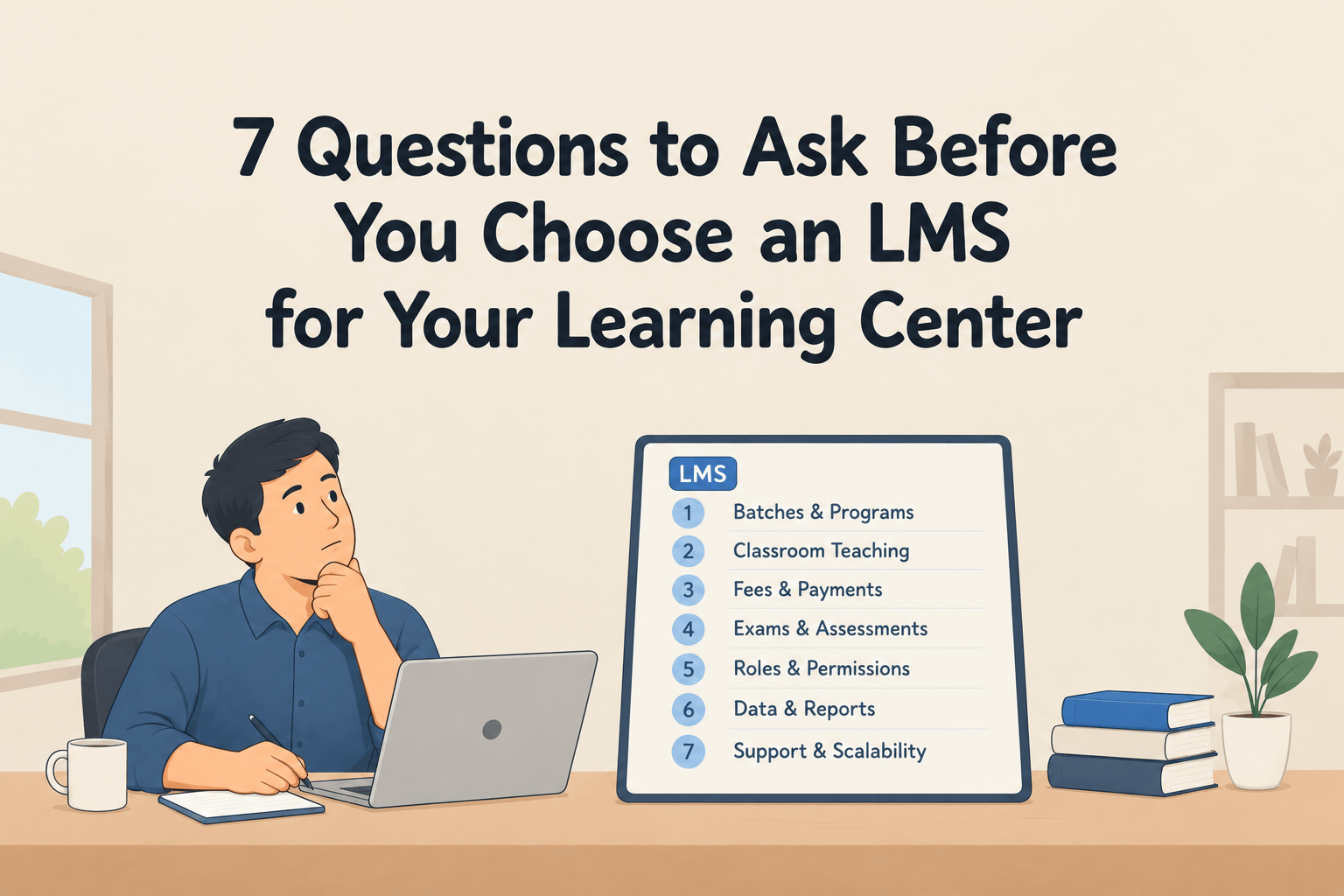
An academy or institution platform. Many instructors, batches with start dates, attendance, fee plans, progression across terms. The complexity here sits in operations rather than content delivery. Our guide to choosing an LMS for a learning center goes through the seven questions that matter at this scale.
A marketplace. Outside instructors publish, you take a share, money moves in both directions. This is where RaftLabs' $250,000 to $400,000 range comes from, and the software is the easy half. A marketplace needs learner demand before it needs a catalogue.
Most platforms that end up as marketplaces do not start as one. They start as a single institution running its own courses, then open to outside instructors once there is traffic worth sharing.
Step 2: Choose Your Route, With Open Eyes
There are three ways to get a platform, and the honest comparison looks like this.
| Custom build | Self-hosted open source | Hosted platform | |
|---|---|---|---|
| Upfront cost | $40,000 – $400,000 | Licence free, setup paid | Subscription |
| Time to launch | 3 – 14 months | 1 – 3 months | Days to weeks |
| Who maintains it | You | You | The vendor |
| Who fixes it at 2am | You | You | The vendor |
| Changes to the product | Anything, at a price | Anything, with a developer | What the roadmap allows |
| Running cost at scale | Hosting plus video plus a team | Hosting plus video plus a team | Subscription |
Custom development earns its cost in one situation: your teaching workflow is genuinely unlike anything on the market, and the difference is the thing you sell. Accreditation bodies with unusual assessment rules, regulated training with specific audit requirements, research institutions with their own pedagogy. If you can describe your requirement and a salesperson nods along, it is not unusual.
Open source such as Moodle or Open edX removes the licence fee and nothing else. The software is free. Hosting, upgrades, security patches, video storage, plugin conflicts and the person who understands all of it are not. Universities make this work because they already employ that person.
A hosted platform trades control for speed. You cannot change how the product works, but you also do not maintain it, and the subscription replaces both the build and the engineering salary behind it.
Step 3: Match the Platform to How You Teach
Feature lists are a poor way to compare platforms, because every product lists the same forty things. Teaching models are a good way, because most products only do one well.
Self-paced. Learners buy and start whenever. You need content delivery, drip scheduling, assessments and certificates. This is the model almost every platform supports.
Cohort-based. A group starts together, follows a schedule, finishes together. You need cohort management, bulk enrolment and the ability to run the same course again next term without duplicating it. Many course platforms have no concept of a group at all.
Live and blended. Sessions happen at a time, online or in a room, with recordings afterwards. You need live classes, recorded lessons and bookings for one-to-one slots.
Multi-instructor. Several teachers, each with their own classes and their own share of revenue. You need instructor management and role permissions that stop a part-time teacher from seeing the accounts.
If you teach in more than one of these modes, check that one account handles all of them. The common failure is a platform that does self-paced beautifully and treats everything else as a workaround.
Step 4: The Features You Need on Day One
Six things. Everything else is a second-release decision, and treating it otherwise is the most reliable way to miss a launch date.
- Enrolment. Learners get in, individually or in bulk, and you can see who is in what.
- Course delivery. Courses with lessons, video, files, and a sensible order.
- Payments. Money arrives, and you can see what arrived and what has not.
- Assessment. Quizzes or assignments, enough to tell whether anyone learned anything.
- Progress reporting. Who finished, who stalled, per learner and per group.
- Roles. Permissions that separate instructors, administrators and learners.
The features most often built first and used least: gamification, a mobile app before there is a reason for one, AI recommendations on a catalogue of nine courses, and analytics dashboards nobody opens. Each is defensible in year two and expensive in month one.
For the longer version of this exercise, with scoring, our LMS buying guide walks through evaluation step by step, and types of learning management systems covers which category fits which organisation.
Step 5: Make It Yours, and Check Who Owns What
A platform people recognise as yours is worth more than the same platform under someone else's name, and the difference is mostly configuration rather than code.
Put it on your own domain. Running courses on a subdomain of your vendor's website means every link anyone shares, and every year of search equity you earn, builds their brand next to yours. Our own website builder exists for this reason.
Use your own branding on the learner-facing side, including emails. Learners should not have to learn a second company's name to take your course.
Then settle ownership before you commit, in writing:
- Can you export student records, course content, question banks and payment history, in a usable format, whenever you want?
- Where is learner data stored, and under which jurisdiction?
- Is there an audit trail of who changed what?
- Does the price scale with enrolment, so that success raises the bill?
A vendor who answers the export question plainly expects to keep you by being useful. One who redirects the conversation has answered it a different way.
Step 6: Get the First Hundred Learners Onto It
A platform with no learners is a website. The work after launch matters more than the platform choice, and it is the part the development quotes never include.
Start with people who already know you. Past students, a mailing list, a community, colleagues who refer. The first hundred enrolments almost never come from search, and a platform that launches to strangers usually launches to nobody.
Run the first cohort small and deliberately. Ten learners who finish and say something useful about it are worth more than two hundred who sign up and drift, because they produce the evidence that sells the second cohort.
Fix the enrolment path before you spend on traffic. Count how many people reach the payment screen and how many complete, and read the gap honestly. Most platforms lose more learners to a confusing sign-up than to a missing feature.
Then publish what you teach, in public, repeatedly. The institutions whose platforms grow are the ones producing something worth linking to, not the ones with the best feature set.
Step 7: What to Measure Before You Scale
Four numbers tell you whether the platform is working. Everything else is decoration until these are healthy.
Completion rate per cohort. Low completion is a content or pacing problem, and no feature fixes it. Completion reports by group rather than by individual show it fastest.
Enrolment conversion. Of the people who reach your course page, how many enrol. A platform that makes this worse than your old sign-up form is costing you money every week.
Repeat enrolment. What share of learners take a second course. This is the single number that separates a business from a launch, and it is the one most teams never calculate.
Cost per active learner. Your total monthly platform spend divided by learners who actually used it. Run this against the RaftLabs hosting figures above before you consider self-hosting, because that is the comparison that decides it.
Can You Build a Platform Like Udemy or Coursera?
Yes, and the quote is $250,000 to $400,000 over 9 to 14 months for a marketplace with creator payouts, content review and mobile apps, according to RaftLabs. The software is not the obstacle.
Udemy and Coursera are demand businesses. Their value is the learners already there, which is what makes instructors publish, which is what attracts more learners. A new marketplace starts with neither side of that loop and has to buy one of them.
The route that works more often: run your own courses first, build an audience that belongs to you, then open the catalogue to outside instructors once there is traffic worth sharing. At that point you need instructor management, revenue shares and an approval workflow, and you need them with a real audience behind them rather than ahead of them.
Where Most Platform Projects Go Wrong
Buying the roadmap instead of the product. Features promised for next quarter have a way of staying there. Evaluate what exists today.
Scoping for year three. Multi-tenancy, SSO and an API you will not call for two years each add months to a build. RaftLabs prices multi-tenant architecture as a separate $80,000 to $120,000 phase for a reason.
Forgetting the running cost. A build budget without a hosting and video line is not a budget. At 10,000 learners that line is $4,000 to $9,000 a month on RaftLabs' own numbers.
Choosing on price alone. The cheapest platform that cannot run your teaching model costs you staff hours every week, and that overtakes the subscription difference within a term.
Migrating everything on day one. Move one course and one cohort first. Products behave differently once the data is real.
Your Next Step, Based on Where You Are
You teach already and want your own platform. Skip the build conversation. Run one course on a hosted platform, with your domain and branding, and judge it on a real cohort. The pricing page is the whole cost, and what an LMS means covers the vocabulary if any of this is new.
You run a centre or academy with batches and fees. Your requirements are operational rather than technical. Work through the seven questions for a learning center before you look at any product.
You are weighing a quote from a development agency. Take the table at the top of this page into that meeting. Ask what the monthly hosting and video cost will be at 10,000 learners, who maintains it in year three, and what it costs to add SCORM or SSO later. The answers usually reframe the decision.
You genuinely need something bespoke. Then build it, and budget for maintenance from the first day rather than the first outage. Edushade supports tutors, academies and training teams, and if none of those shapes fit yours, a custom build may be the honest answer.
Cost figures on this page were taken from the published pages of Creole Studios and RaftLabs in October 2026. Both sell custom development services. Check current figures with any vendor before budgeting.