
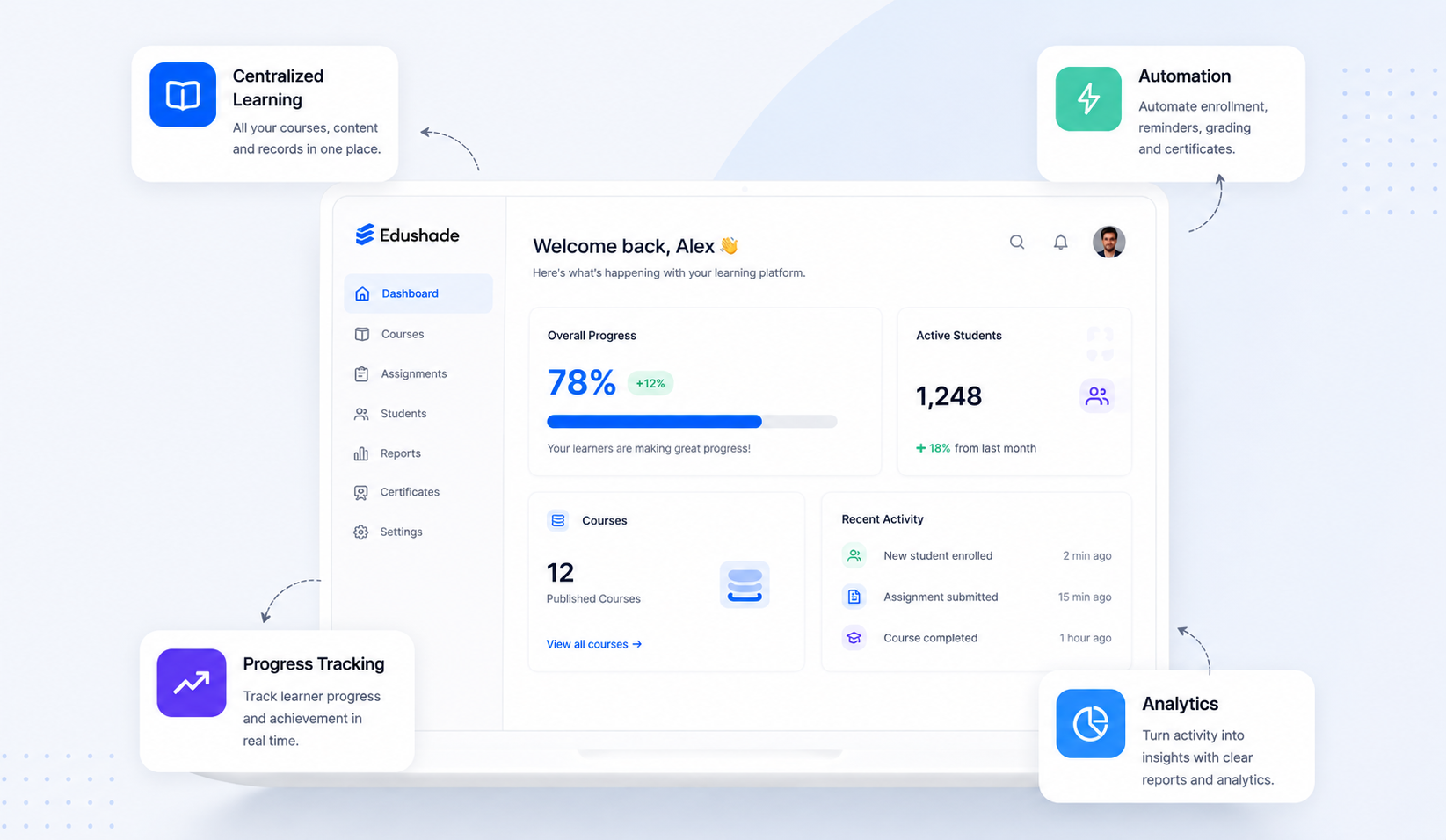
The benefits of an LMS include centralised course management, flexible access, consistent training, faster updates, clearer progress tracking and less repetitive administration. For teams, the deeper value is shared visibility: learners know what to do, instructors see where support is needed, and leaders can connect learning activity with practical goals—provided the platform, content and implementation are well designed.
What Are the Main Benefits of an LMS?
A Learning Management System brings courses, users, teaching activities and learning records into one structured platform. Its main purpose is not simply to put lessons online. It helps an organisation manage how learning is delivered, completed, assessed and improved.
The OECD describes Learning Management Systems as part of an organisation’s digital education infrastructure. They can manage learner information, classes and teachers while also providing access to digital teaching and learning content.
The practical advantages of an LMS depend on how it is configured and used. A good platform can remove unnecessary friction, but it cannot compensate for unclear learning goals, weak content or a lack of support.
| Benefit of an LMS | Practical value |
|---|---|
| Centralised learning | Courses, users and records stay in one place |
| Flexible access | Learners can study across locations and schedules |
| Consistent delivery | Each learner receives the intended course experience |
| Reduced administration | Routine processes require less manual handling |
| Progress tracking | Instructors can see activity, results and completion |
| Scalable delivery | Programmes can serve more learners and cohorts |
| Faster updates | Content can be revised centrally |
| Better communication | Announcements and feedback stay connected to learning |
| Data-informed improvement | Course activity can reveal areas needing attention |
| Stronger continuity | Knowledge remains available when teams change |
| Clearer records | Completion, grades and certificates can be documented |
| Connected workflows | Learning tools and business systems can work together |
1. An LMS Creates One Source for Learning
Centralisation is one of the clearest benefits of LMS software. Courses, resources, enrolments, assignments, grades and learner records can be managed within one system instead of being scattered across email, spreadsheets, file drives and messaging apps.
For learners, one source reduces uncertainty. They know where to find lessons, deadlines and feedback. For instructors, it reduces the risk of sending outdated files or maintaining several versions of the same course material.
For administrators, centralisation creates a clearer operational view. A learner’s account can connect their course access, activity, results and completion history rather than treating each record as an unrelated task.
2. Learners Gain More Flexible Access
An LMS can let learners access education or training across locations, devices and time zones. This supports remote teams, international cohorts, working professionals and people who cannot attend every session at a fixed place and time.
Flexible access does not require every course to become self-paced. A Learning Management System can support live classes, independent lessons or blended learning, where scheduled teaching is combined with online activities.
Access still depends on thoughtful design. UNESCO advises that digital learning platforms should consider accessibility, low-cost devices and intermittent connectivity rather than assuming that every learner has the same technology or internet connection.
3. Course Delivery Becomes More Consistent
An LMS helps an organisation deliver the same core curriculum, instructions and assessment requirements to each learner. This is particularly useful when several instructors teach the same programme or when training runs repeatedly.
Consistency does not mean removing an instructor’s judgement. Teachers and trainers can still adapt explanations, give individual feedback and offer extra support while working from a shared course structure.
For businesses, consistent training can also reduce confusion between departments or locations. Every participant can receive the approved version of a process, policy or onboarding programme.
4. Teams Spend Less Time on Repetitive Administration
A Learning Management System can reduce manual work by handling enrolment, scheduled content, reminders, completion rules, grades and certificates. The time saved depends on the workflow and should be tested rather than assumed.
Consider a training business that currently sends joining instructions manually, tracks attendance in a spreadsheet and creates certificates one at a time. An LMS may connect these steps so the team spends less time transferring information between tools.
Automation works best when the underlying process is clear. Automating a confusing enrolment rule or an unnecessary approval stage will make that process faster, but not necessarily better.
5. Progress Becomes Easier to See
Progress tracking gives learners, instructors and administrators a shared view of what has been completed. Depending on the platform, this may include lessons viewed, assignments submitted, quiz results, attendance and overall course completion.
Learners benefit because they can see what remains to be done. Instructors benefit because they can identify incomplete activities or weak assessment results before the end of a programme.
Edushade’s progress and grading tools document lesson, quiz and assignment tracking, completion rules, weighted grades and marksheets. This shows how separate learning activities can contribute to one course-level record.
6. Instructors Can Give More Timely Support
An LMS can help instructors spot where support may be needed. A learner who has missed several activities, stopped progressing or struggled with the same assessment topic may require a reminder, explanation or different learning resource.
Activity data does not explain everything. A missed lesson could reflect confusion, workload, illness, connectivity problems or a simple tracking error. Instructors should use LMS data as a prompt for conversation, not as a final judgement about ability or motivation.
When used carefully, learning analytics can support course review and teaching decisions. EDUCAUSE notes that analytics can help teams investigate learning patterns, but meaningful improvement still requires educators to interpret the evidence and examine the underlying teaching problem.
7. Learning Results Can Be Measured More Clearly
An LMS creates a stronger connection between learning activity and stated outcomes. Course designers can align lessons, assignments and assessments with the knowledge or skills learners are expected to develop.
Clear measurement begins with clear objectives. A high completion rate does not prove that learners can apply a skill, just as a low score does not automatically reveal why someone struggled.
MIT’s digital learning guidance recommends aligning assessments with specific learning objectives and course outcomes. An LMS can support that structure, but the quality of the result depends on the assessment design.
8. Courses Can Scale Without Rebuilding Everything
Scalability is an important LMS benefit for academies, universities, course creators and training teams. Once a course structure is established, it may be reused for new learners, departments, clients or scheduled cohorts.
Scaling through an LMS can preserve consistency while allowing different enrolment rules, instructors or delivery dates. A single course can form part of several learning paths or be offered to separate groups.
Technology alone does not guarantee smooth growth. Organisations should confirm user limits, storage, reporting capacity, support availability and pricing before assuming that a platform will meet future demand.
9. Content Is Easier to Update and Reuse
An LMS makes it possible to update a lesson at its source rather than replacing copies in several folders. This is useful when a process changes, a resource becomes outdated or an instructor finds a clearer explanation.
Reusable content can also reduce duplicated work. A lesson on communication skills, for example, might appear in an onboarding programme, a management pathway and a customer-service course.
Edushade’s guide to courses, learning paths and cohorts explains how lessons, quizzes, assignments and files can be organised into courses, grouped into wider programmes and delivered to scheduled learner groups.
10. Communication Stays Connected to the Course
Announcements, feedback and learning discussions are more useful when they appear beside the relevant course activity. Learners do not have to search through unrelated messages to understand which lesson or assignment an update concerns.
An LMS may also support notifications for deadlines, new content or assessment results. These reminders can improve clarity, but too many automated messages can quickly become noise.
Communication tools should therefore be configured around meaningful events. A useful notification tells a learner what changed, why it matters and what action to take next.
11. Organisations Keep Clearer Learning Records
An LMS can maintain records of enrolment, assessment, completion and certification. This is useful for academic reporting, professional development, employee onboarding and programmes where participants need evidence of achievement.
A completion record is not automatically proof of competence or regulatory compliance. Organisations must define what completion means, use appropriate assessments and check any legal or professional requirements that apply.
The value lies in traceability. Teams can see which course was assigned, which version was delivered, what the learner completed and what evidence was produced.
12. Learning Can Connect with Other Systems
An LMS may need to connect with identity systems, video tools, payment providers, content libraries, student information systems or business reporting platforms. Effective integrations can reduce duplicate accounts and manual data entry.
Interoperability standards can make these connections more reliable. The 1EdTech Learning Tools Interoperability standard defines a common way for learning platforms and external tools to exchange authorised information.
Buyers should verify the exact integration rather than relying on a logo or broad compatibility claim. Important questions include which data is exchanged, how often it is updated and what happens when an integration fails.
Who Benefits Most from an LMS?
Learners, educators and organisations benefit in different ways. A strong LMS strategy considers all three perspectives instead of optimising only for administrators or decision-makers.
| User | Main LMS benefits |
|---|---|
| Learners | Clear course structure, flexible access and visible progress |
| Instructors | Easier delivery, assessment, feedback and course updates |
| Administrators | Centralised users, enrolment, records and reporting |
| Managers | Better visibility into participation and completion |
| Course creators | Reusable content, learner management and programme delivery |
| Training businesses | Repeatable operations across courses, clients and cohorts |
| Schools and universities | Structured teaching, assessment and academic records |
A system can fail when one group’s needs dominate. An advanced reporting dashboard has limited value if learners cannot navigate the course or instructors need excessive training to complete routine tasks.
What Business Results Can an LMS Support?
An LMS can support better business results by making learning easier to deliver, repeat and measure. Possible outcomes include faster onboarding, clearer skill development, more consistent customer education and more efficient programme management.
The word “support” matters. An LMS does not independently create higher productivity, revenue or learner success. Results depend on relevant content, capable instructors, learner participation and a clear link between training and practical performance.
For a commercial academy, the platform may also connect teaching with enrolment, payments and learner communication. Edushade currently presents course creation, live classes, communities, assessments, certificates, analytics and scheduling within one academy-management environment.
Are There Disadvantages to Using an LMS?
Yes. Common LMS limitations include implementation work, migration difficulty, subscription costs, technical dependence, user resistance and the risk of collecting data without using it responsibly.
Online access can also increase inequality when learners lack reliable devices, connectivity or digital skills. The OECD warns that digital education can widen existing gaps when access, confidence, resource quality and privacy are not addressed.
An LMS can create extra work when it does not match the teaching model. Teams may end up maintaining the platform while continuing to use separate spreadsheets, messages and manual processes.
The right question is therefore not “Does an LMS have benefits?” It is “Which benefits matter to us, and can this platform deliver them without creating greater costs or barriers elsewhere?”
How Can You Measure the Benefits of an LMS?
Measure LMS value against the problem the organisation wanted to solve. Avoid choosing convenient metrics simply because the platform displays them.
A useful measurement plan may include:
- Time required to enrol and support learners
- Course activation and completion rates
- Assessment performance against learning objectives
- Learner and instructor satisfaction
- Support requests and recurring usability issues
- Time needed to update or launch a course
- Cost per learner or programme
- Transfer of learning into practical work
- Data quality and reporting accuracy
Compare results with a clear baseline. For example, record how long onboarding takes before the LMS is introduced, then measure the same process after implementation.
Do not rely on completion alone. A completed course may still have unclear content, weak assessments or little practical impact. Combine platform data with learner feedback, instructor observations and relevant performance evidence.
How Do You Choose an LMS That Delivers Real Benefits?
Choose an LMS by matching its functions to your teaching process, users and intended outcomes. A product with more features is not necessarily a better fit.
Use this checklist before making a decision:
- What learning problem are we trying to solve?
- Who will administer, teach and learn through the platform?
- Which workflows must become easier?
- Do we need live, self-paced, cohort-based or blended delivery?
- Which assessments and reports are essential?
- Can users complete common tasks without extensive training?
- Can existing content and records be transferred?
- Does the platform meet accessibility and privacy requirements?
- Can we export our data?
- What is the total cost at our expected future scale?
- How will we measure success after launch?
Run a realistic trial wherever possible. Ask an administrator to create a course, an instructor to grade an activity and a learner to complete a lesson. That test will reveal more than a long feature comparison.
Turn LMS Features into Meaningful Learning Benefits
The central benefit of an LMS is not the software itself. It is the clearer learning system that the software can support: one place to teach, learn, assess, communicate and improve.
Start by identifying the operational problem that matters most. It may be fragmented tools, inconsistent training, slow onboarding, limited progress visibility or difficulty serving more learners.
Edushade is one option for educators and training organisations looking to bring course creation, live delivery, assessments, communities and learner management into a connected platform. Explore the Edushade Learning Management System to compare its documented workflows with your own requirements.